Matter: The Physics of Science
Matter is almost everything around us. It's something that takes up space, that is weigh able. Such as a desk, pencil, paper and much more.But there are certain things that are not matter, like light, electricity, dream and more.  All matter is made of atoms, atoms are made of protons(positive charged), neutrons (no charge) in the nucleus and electrons (negative charge) revolving around it in energy levels.Atoms bond together to make compounds/elements Matter can be measured :
| Also the size of the object doesn't mean it weighs the same as other objects the same size.
Example: 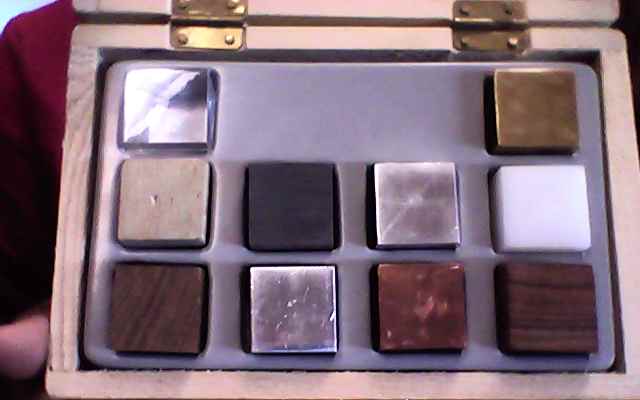 all of them are 1 cubic inch but they weigh differently. The bronze (the second to last on the bottom row) weighs more than the wood ( the first on the middle row). when you measure a matter usually you also find it's density. Density is a measure of the quantity of some physical property (usually mass) per unit length, area, or volume (usually volume). There is two types of density: ♦ Mass density is a measure of the mass of a substance per unit volume. Most substances (especially gases such as air) increase in density as their pressure is increases or as their temperature decreases. ♦ energy density is a measure of the amount of energy (often in the form of electromagnetic radiation) per unit volume in a region of space or some material. |
